
Understanding Protective Refund Claims for COVID-19 IRS Penalties
Updated: Aug 19
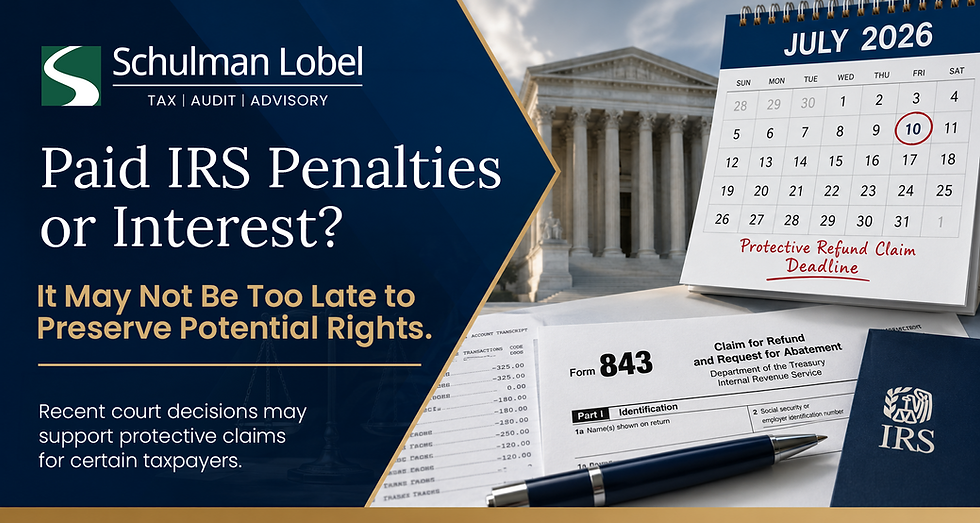
Two recent court decisions, Abdo v. Commissioner, 162 T.C. No. 7 (2024), and Kwong v. United States, 179 Fed. Cl. 38 (2025), open doors for taxpayers. They may file protective claims related to certain IRS penalties and interest due to filing and payment deadlines affected by the COVID-19 federal disaster declaration. If you paid failure-to-file penalties, failure-to-pay penalties, or related interest, review your accounts promptly. The potential deadline for protective filings is July 10, 2026. If you have outstanding penalty assessments, consult your advisors about protective filings or other remedies.
Why Abdo and Kwong Matter
In Abdo, the Tax Court ruled that the disaster relief provisions of Internal Revenue Code Section 7508A(d) require the postponement of specific tax deadlines during federally declared disaster periods. In Kwong, the U.S. Court of Federal Claims took a broader view. It concluded that the COVID-19 federal disaster declaration postponed many federal tax deadlines from January 20, 2020, to July 10, 2023. If the reasoning in Kwong prevails, some taxpayers may challenge penalties and interest that accrued during this period.
Potentially affected items include failure-to-file penalties, failure-to-pay penalties, and related interest charges. These amounts may arise from income, employment, estate, gift, excise taxes, and certain international information return filing obligations. Thus, a wide range of taxpayers, including individuals, businesses, estates, and trusts, should evaluate whether protective claims should be filed while litigation remains unresolved.

What Is a Protective Claim?
The IRS does not currently agree with the broad interpretation adopted in Kwong, and the decision is under appeal. Therefore, taxpayers should not expect automatic refunds or penalty abatements. However, they can preserve their rights by filing a protective claim before the statute of limitations expires. A protective claim allows the IRS to hold a taxpayer's claim open while courts determine the litigation's outcome. Waiting until the litigation is resolved may be too late to seek relief.
Taxpayers assessed IRS penalties or interest should review their IRS account transcripts and related notices to determine if they have a viable claim.
How to File a Protective Claim Using IRS Form 843
Protective claims are generally filed on IRS Form 843, Claim for Refund and Request for Abatement. Clearly identify the submission at the top of the form as a "Protective Claim Pursuant to Kwong." Include a statement describing the penalties, interest, and tax periods involved, along with copies of relevant IRS notices and account transcripts supporting the claim. Depending on the circumstances, a Form 843 may seek either a refund of penalties and interest already paid or abatement of penalties and interest assessed but unpaid. Clearly describe the relief requested and explain why the reasoning in Kwong supports your claim.

Why July 10, 2026 May Be an Important Date
Taxpayers can file a claim for credit or refund within the later of: (i) three years from the date the applicable return was filed, considering extensions, or (ii) two years from the date the tax, penalty, or interest was paid. Under Kwong, the federally declared COVID-19 disaster period (from January 20, 2020, through July 10, 2023) may be disregarded when determining whether certain refund claims are timely. If this interpretation is upheld, some taxpayers may have more time to file refund claims or protective claims than normal limitation periods allow.
The exact effect depends on each taxpayer's filing history, payment history, and the nature of the relief requested. Different limitation periods may apply based on whether the taxpayer seeks a refund of amounts already paid or abatement of amounts that remain unpaid. Additionally, the scope and validity of Kwong are still under litigation.
Taxpayers who paid IRS penalties or interest should review their IRS account transcripts and related notices to determine if they have a viable claim. Many practitioners have identified July 10, 2026, as a conservative date for filing protective claims to preserve potential rights while courts address the scope of Kwong. In some cases, the applicable limitations period may expire earlier, while in others, it may extend beyond July 10, 2026, especially if payments giving rise to the claim were made after July 10, 2023.
Take Action Before Potential Rights Expire
If you paid IRS penalties or interest related to filing or payment obligations during the COVID-19 federal disaster period, consult with your Schulman Lobel advisor. Given the approaching deadline and uncertainty surrounding the applicable limitation periods, evaluate potential claims promptly. This will help you avoid inadvertently losing the opportunity to seek a refund or other possible relief.

To discuss whether you may have a viable protective refund claim or to receive assistance preparing and submitting a claim, please contact Len Sprishen, J.D., LL.M., Partner, Schulman Lobel Advisors, LLC. Mr. Sprishen can help assess your specific circumstances, review applicable IRS records, and advise on steps that may be available to preserve your refund rights pending further developments in the litigation.


Comments